


For years, the default path to the U.S. for Indian professionals was simple, get a job, move on an H-1B, and wait for a Green Card. Today, that wait can stretch into decades.
For high-net-worth Indians who don’t want their family’s future tied to employer sponsorship or endless visa renewals, that uncertainty is no longer acceptable. And that’s exactly why the EB-5 visa program is always there in serious conversations.
The EB-5 offers a direct path to permanent residency through investment. No employer dependency. No lottery system. Your spouse and children receive green cards alongside you.
This guide will explain EB-5 from ground up for Indian HNIs. What it is, why it’s attracting Indians now, how the process works, and what unique considerations you should know before diving in.
What is the EB-5 Visa?
The EB-5 is a U.S. immigrant visa program to attract foreign capital and create American jobs. The logic is simple, invest in the U.S. economy and earn permanent residency.
To qualify, an investor must:
- Invest in a new commercial enterprise
- Create at least 10 full-time U.S. jobs
- Invest $800,000 in a Targeted Employment Area
- Prove funds are lawful
In return, the investor, spouse, and unmarried children under 21 receive green cards. Parents are not included and they can only be sponsored later after U.S. citizenship.
You invest in a government-approved project often in real estate or infrastructure and remain a passive investor. Job creation can include indirect and induced jobs calculated through economic models.
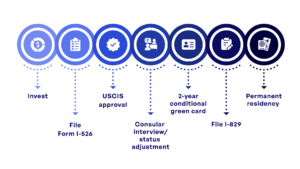
The EB-5 Flow
Invest → File Form I-526 → USCIS approval → Consular interview or status adjustment → 2-year conditional green card → File I-829 → Permanent residency
Why Indian HNIs Are Looking at EB-5 Now
Short answer: Several structural shifts in both the U.S. and India are driving this surge.
Long answer:
1.Employment Green Card Delays
Indian applicants in EB-2 and EB-3 categories face long waiting periods due to per-country limits.
EB-5 offers a more direct pathway, subject to annual visa caps but historically more predictable for investors.
As the Times of India notes, “long wait times stretching into decades for employment-based Green Cards” are pushing Indians toward EB-5. Source
2.Family Security and Flexibility
One of our clients, a Mumbai-based entrepreneur, has two daughters in an international school. His concern wasn’t lifestyle. It was certainty. He didn’t want their university access or career choices dependent on visa renewals.
With EB-5:
- Children qualify as residents
- No employer dependency
- Freedom to work, start businesses, or study without visa renewals
For many families, this is about generational positioning.
3.Policy Clarity
The EB-5 Reform and Integrity Act set current investment thresholds and extended the Regional Center program through September 30, 2027.
Rules exist. Oversight exists. The pathway is defined.
That matters to serious investors.
Step-by-Step EB-5 Process
The EB-5 journey unfolds in phases, often spanning 4 to 7 years. Below is an infographic style timeline and investment flow:
Expert Consultation & Project Selection
Consult immigration and financial advisors. Select a USCIS-approved Regional Center project aligned with your residency goals.
Document Lawful Source of Funds
Prepare a complete paper trail for every rupee invested. Funds must be clearly traceable and legally earned.
RBI / LRS Compliance & Fund Transfer
Remit funds under India’s Liberalised Remittance Scheme with proper banking and tax documentation. Capital must remain at risk.
File EB-5 Petition (Form I-526 / I-526E)
Submit your investment and job creation plan to USCIS. Processing typically takes 12–24 months.
Conditional Green Card (2 Years)
After approval and visa availability, complete consular processing or adjustment of status. You receive a 2-year conditional Green Card.
File Form I-829 Petition
File within 90 days before the 2-year mark, proving 10 jobs were created. Approval leads to permanent residency.
Final Outcome
Permanent Green Card → Eligible for U.S. citizenship after 5 years (if residency requirements are met).
Timeline Summary: From I-526 filing to permanent Green Card is typically 4–6 years. Source
Capital is usually returned after about 4 to 6 years once conditions are removed.
EB-5 Visa Cost Breakdown for Indian Investors
Before committing, you need a clear view of the total EB-5 investment cost, not just the headline number.
Here’s what you’re realistically looking at.
- Capital Investment
This is the core requirement:
- $800,000 in a Targeted Employment Area (TEA)
This amount must remain “at risk” until job creation requirements are met.
- USCIS Filing Fees
Government filing costs include:
- $3,675 for Form I-526
- ~$850 per family member (if adjusting status inside the U.S.)
- ~$345 per person for immigrant visa issuance
These fees are fixed and non-refundable.
- Legal and Professional Fees
Most Indian HNIs spend between $50,000 to $150,000 on professional services.
This typically covers U.S. immigration lawyers, Indian FEMA/RBI advisors, source-of-funds documentation experts, project due diligence and advisory support.
- Tax on Foreign Remittance (TCS)
Under Indian tax rules, remittances above ₹10 lakh attract 20% Tax Collected at Source (TCS)
Important: TCS is adjustable or refundable against your income tax liability, but it impacts immediate cash flow.
- Additional and Hidden Costs
Investors often underestimate:
- Travel and relocation expenses
- Translation and documentation costs
- U.S. tax compliance after becoming a resident
- Opportunity cost of locking $800k+ for 4–6 years
Capital is typically returned after conditions are removed, but timing depends on the project structure.
EB-5 Visa Cost Summary
| Expense | Amount/Rate (approx.) |
| Capital Investment | $800,000 (TEA) – $1,050,000 (other areas) |
| USCIS Filing Fee (I-526) | ~$3,675 (principal) |
| Legal & Due Diligence | $50,000 – $150,000 |
| Visa Processing Fee | ~$345 per applicant (DS-260) |
| Tax (TCS on remittance) | 20% on amounts > ₹10 lakh |
| Bank Transfer Costs | Varies by bank; includes SWIFT, FIRC charges |
| Travel/Relocation | Round-trip tickets + settlement costs |
EB-5 Investment Risks for Indian Investors
EB-5 is not a fixed deposit. Your capital is legally required to stay at risk, which means outcomes depend on both the project and policy environment.
The two risks that matter most:
- Project Risk – If the project fails to create 10 full-time U.S. jobs, your permanent Green Card can be denied and capital recovery may be delayed or reduced.
- Regulatory & Compliance Risk – Visa caps, policy shifts, RBI/LRS structure errors, or documentation gaps can complicate the process.
We break down these risks clearly including what actually goes wrong in real cases and how sophisticated investors mitigate them in this video:
If you’re considering deploying $800,000, this is worth your time.
Is the EB-5 Visa Right for You?
The EB-5 visa can be a powerful tool for Indian HNIs seeking U.S. residency, but it comes with major responsibilities and hurdles. Before you commit, run through this decision checklist:
Ask yourself:
- Can you deploy ₹7 to 9+ crore of fully traceable funds for 4 to 6 years?
- Are you comfortable with capital staying at risk?
- Can you manage RBI/LRS compliance and global tax implications properly?
- Do you want your spouse and children under 21 included?
- Are you willing to live in the U.S. long term?
If the answers are largely yes, EB-5 can be a strategic move.
If not, that clarity is equally important. This is a residency decision backed by capital and not a financial investment play.
Frequently Asked Questions
What Is the EB-5 Investor Visa?
The EB-5 is a U.S. green card program designed for foreign investors. By investing approximately $800,000 in a qualifying U.S. business and creating at least 10 full-time jobs for American workers, you and your immediate family can obtain permanent residency in the United States.
How Much Do I Need To Invest For EB-5?
You must invest:
-
$800,000 if the project is located in a Targeted Employment Area (TEA)
-
$1,050,000 if the project is outside a TEA
The investment must be placed in an eligible U.S. commercial enterprise and remain at risk for the required period.
How Long Does The EB-5 Process Take?
The full process typically takes around 4 to 7 years.
Here is the general timeline:
-
I-526 petition processing: approximately 12 to 24 months
-
Conditional green card period: 2 years
-
I-829 petition processing: approximately 18 to 24 months
Timelines can vary depending on USCIS workload and country-specific backlogs.
Can My Family Get Green Cards With Me?
Yes. Your spouse and unmarried children under 21 years of age receive green cards along with you.
Parents are not included under the EB-5 application. You can sponsor them only after you become a U.S. citizen.
Will I Get My Money Back, And What Returns Can I Expect?
EB-5 investments are not guaranteed and must remain at risk to qualify under program rules.
If the project performs successfully, capital is usually returned in about 4 to 6 years. Financial returns are generally modest, typically around 1 to 2 percent annually.
The primary objective of the EB-5 program is obtaining permanent residency, not generating high investment returns.
____________________________________________________________________________________
Disclaimer: This content is for educational purposes only and does not constitute legal, tax, or investment advice. EB-5 involves immigration and financial risk. Outcomes are not guaranteed. Viewers should consult licensed immigration attorneys and qualified professionals before making decisions.